

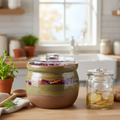


Tap your own birch sap / kit for tapping birch sap, tapping kit 5 litres, glass demijohn
Regular price
197,00 kr
Sale price
Regular price
Tax included.
Shipping calculated at checkout.
Available in stock
Couldn't load pickup availability
Description
Description
The kit consists of:
- 1 glass demijohn, 5 litres
- 1 metre of PVC plastic tubing
- 1 plastic tapping spout
- 2 dowels for plugging the hole after tapping
- 1 x 50 mm rubber cap to fit over the demijohn. You simply cut a small hole in the cap for the tube with a craft knife
Before fitting the tube onto the tapping spout, soften one end in water at approx. 40 °C. It will then slide on easily.
All products are approved for food contact.
Can you drink birch sap?
Yes – and you can even get hooked on it. At least two members of our family already have!
Tapping birch sap is an old tradition in Scandinavia, especially in Sweden and Finland, as well as in Russia. As far back as the 18th century, Danish literature describes birch sap as having ‘a not unpleasant taste’ and as a remedy for several ailments. The sap contains approx. 1–2% sugar and many minerals.
Birch sap can be tapped from the moment the sap starts rising in the birch tree. After a typical winter, that means from around mid-March until the trees come into leaf in April.
Birch sap can be drunk fresh, straight from the tree, or served chilled.
The sap can also be used in baking, ice cream, other cooking and beer brewing. Bread baked with birch sap seems to rise more than other bread and gets a delicate flavour. Birch sap can also be reduced to a thick syrup for use in desserts and sauces.
In cooking, it acts as a flavour enhancer. Try adding a little birch sap when making a goulash, stew or similar dish and let the family be the judges. The same goes for fruit purée sorbets, where the flavour of the berries becomes more nuanced. The sorbet also stays softer at lower temperatures than usual.
Fresh birch sap keeps for approx. 5 days in the fridge. Birch sap is also very well suited to freezing until the next tapping season, so you can enjoy it all year round. The sap can be frozen in plastic canisters (see item number 4305) or bag-in-box bags (see item numbers 3066 and 3067). Remember that the sap expands when frozen, so canisters / bag-in-box bags should not be filled completely. After thawing, birch sap keeps for approx. 5 days in the fridge.
You can also bottle the fresh birch sap and pasteurise it in a pasteuriser (see item number 3341). Stored in a cool, dark place, pasteurised sap can keep for several years.
Let's get started:
First, pick out a tree of a suitable thickness. It shouldn't be too old, nor too young. A tree with a diameter of at least 12–14 cm is ideal.
To tap birch sap, drill a hole in the trunk approx. 70–80 cm above the ground, using a drill bit with a diameter of approx. 9 mm. Choose a smooth area without growths or knots. Drill at a slight upward angle, so that gravity helps the sap flow out of the tree. Drill approx. 6–10 cm into the tree, but no further than the centre of the trunk. Then rinse out the hole with warm water if needed. The outer approx. 5 cm of the tree consists of living sapwood, where the sap is carried up to the crown through ‘pipes’ known as vessels. These vessels are what you tap. In the central wood, the heartwood, these vessels are closed, so there's no need to drill too deep.
Once the hole has been drilled, tap the spout into the tree with a few light blows of a hammer. The ridges ensure that the spout fits tightly, and the ridges at the other end make it easy to attach the tube securely.
Fit the tube onto the spout and connect it to the bucket.
Check the tapping at each tree once or twice a day, as in good weather a large tree can yield up to 10–12 litres of sap in 24 hours. As a curiosity, birch trees seem to be early risers: the most sap usually flows in the early morning, then tails off towards the afternoon.
When you have finished tapping, hammer a wooden dowel into the hole – as far in as possible, and in any case far enough for the end of the dowel to be flush with the bark. The bark will then heal over within a couple of years. Dowels that can't be hammered all the way in should be sawn off flush with the trunk. Please note: Opinions differ as to whether using a dowel is best for the tree. Some studies suggest that it may encourage fungal attack. Without a dowel, however, the tree will undoubtedly lose a good deal of sap before it heals. So it's up to you whether you use dowels or not.
Please note: Only tap the same tree once every 2 to 3 years or so, as tapping the same tree every year may weaken it. A single tapping over a 2–3-year cycle will not weaken the tree. Never reuse a hole. Drill a new hole every time you tap a tree, as the hole from previous tappings may be infected with fungi, bacteria and the like.
If the sap that comes out isn't clear, discard it and stop tapping from that hole. Instead, you can drill a new hole elsewhere on the same tree and continue there. Milky sap may be caused by bacteria in the drill dust, so remember to clean thoroughly before you start tapping.
Wash all equipment thoroughly before moving it to another tree.
Spouts and tubes should also be sterilised in boiling water every 5–7 days, especially in milder weather.
Canisters and buckets can be cleaned with bottle and demijohn cleaner (item number 3018).
Good luck with your tapping in the woods!
Canisters and buckets can be cleaned with bottle and demijohn cleaner (item number 3018).
Fresh birch sap keeps for approx. 5 days in the fridge. In our experience, the sap can be kept cool in bag-in-box bags (see item numbers 3066 and 3067) for at least 3 weeks, as it is not exposed to oxygen with this storage method. Birch sap is also very well suited to freezing until the next tapping season, so you can enjoy it all year round. The sap can be frozen in plastic canisters (see item number 4305) or bag-in-box bags (see item numbers 3066 and 3067). Remember that the sap expands when frozen, so canisters / bag-in-box bags should not be filled completely. After thawing, birch sap keeps for approx. 5 days in the fridge.
watch an introduction to birch sap tapping here
Good luck!
What's included
What's included
Instructions/user guide
Instructions/user guide
Please note
Please note


